






Time:2026-04-21 Views:132
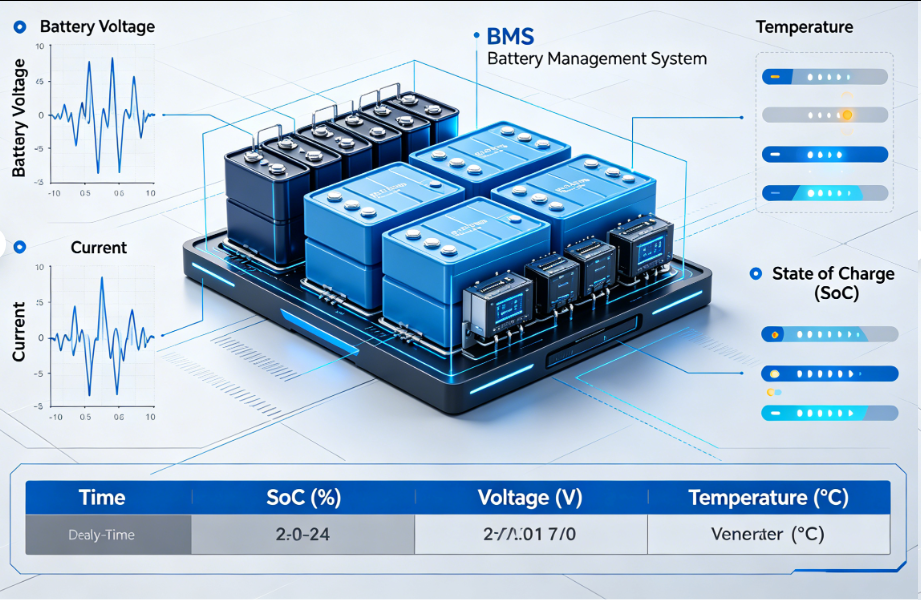
The monitoring of energy storage battery systems is an essential part of ensuring their safe, stable, and efficient operation, as it can real-time track the working status of the battery system, identify potential faults in a timely manner, and optimize the charging and discharging strategy to extend the battery life and reduce maintenance costs. With the increasing scale and complexity of energy storage battery systems, the requirements for monitoring technology are also constantly improving, and modern energy storage battery monitoring systems have developed from simple parameter monitoring to intelligent, integrated, and remote monitoring. The core of the monitoring system is the battery management system (BMS), which is responsible for collecting, processing, and analyzing various parameters of the battery system, providing data support for the safe and efficient operation of the system.
The key monitoring parameters of energy storage battery systems include state of charge (SOC), state of health (SOH), remaining useful life (RUL), state of function (SOF), state of energy (SOE), state of safety (SOS), and state of temperature (SOT). SOC refers to the remaining capacity of the battery, which is crucial for determining the charging and discharging strategy of the system; SOH reflects the health status of the battery, including the degree of capacity degradation and internal resistance increase; RUL predicts the remaining service life of the battery, helping users arrange maintenance and replacement in advance; SOS monitors potential safety hazards such as overcharging, over-discharging, overheating, and short circuits, and issues alarms in a timely manner to prevent safety accidents such as fires and explosions. In addition, the monitoring system also needs to track parameters such as battery voltage, current, and internal resistance, which can reflect the working status of the battery in real time and provide a basis for fault diagnosis.
Modern energy storage battery monitoring systems are increasingly integrated with smart technologies such as AI, IoT, and big data, realizing intelligent monitoring and management. Through IoT technology, the monitoring system can collect real-time data of the battery system and upload it to the cloud server, allowing users to remotely monitor the working status of the battery system through computers, smartphones, and other devices, and receive fault alarms and operation suggestions in a timely manner. For example, the online monitoring system for storage batteries in substations can upload monitoring data to the cloud server through Ethernet, establish a large database, and repeatedly train the battery model to analyze the maintenance operations and performance status of the battery, realizing early prediction of the battery’s health status and ensuring the safety of the battery. AI algorithms can analyze the collected data, identify abnormal patterns, predict potential faults, and optimize the charging and discharging strategy of the battery system, improving energy utilization efficiency and extending battery life.
The application of monitoring systems varies in different scenarios. In grid-scale energy storage systems, the monitoring system needs to monitor the operation status of hundreds or thousands of battery modules, ensuring the stable operation of the entire system and providing data support for grid dispatching. In home energy storage systems, the monitoring system is more user-friendly, allowing users to easily view the remaining capacity, charging and discharging status, and electricity consumption of the battery through smart terminals, and set charging and discharging time periods according to their own needs. In commercial and industrial energy storage systems, the monitoring system is integrated with the enterprise’s energy management system, realizing the unified monitoring and management of energy storage, power consumption, and power supply, helping enterprises reduce energy costs. With the continuous development of monitoring technology, the future energy storage battery monitoring system will be more intelligent, accurate, and reliable, providing stronger support for the safe and efficient operation of energy storage battery systems.




 59911926@qq.com/sales@goldenfuturehk.com
 13316809242 / 15816897019
 Inquiry
 Home >