





Time:2026-04-18 Views:183
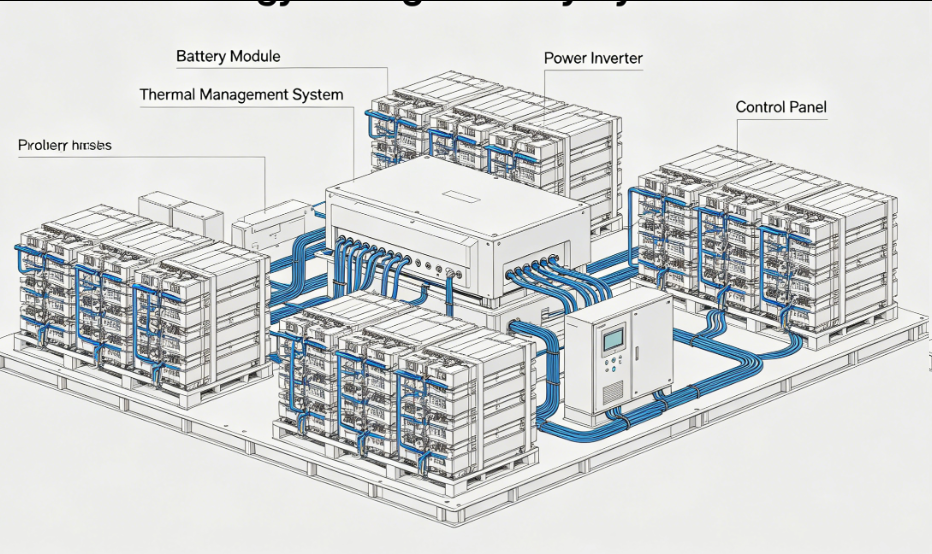
The charging and discharging efficiency of energy storage battery systems is a core indicator that determines the energy utilization rate and economic benefits of the entire energy storage system. It refers to the ratio of the electrical energy output by the battery during discharge to the electrical energy input during charging, usually expressed as a percentage. In practical applications, this efficiency is affected by multiple factors, including battery type, charging and discharging rate, operating temperature, and system configuration, and it is difficult to achieve 100% due to inevitable energy losses.
Different types of energy storage batteries have significant differences in charging and discharging efficiency. For example, lithium-ion batteries, which are widely used in household and industrial energy storage, generally have a charging and discharging efficiency of 85% to 95%. This is because lithium-ion batteries have the advantages of low internal resistance and small energy loss during charge-discharge cycles. In contrast, lead-acid batteries, which are relatively mature and low-cost, have a lower efficiency, usually between 70% and 80%, due to their higher internal resistance and more obvious polarization phenomenon during charging and discharging. In addition, flow batteries, which are suitable for large-scale energy storage projects, have an efficiency of about 75% to 85%, and their efficiency is closely related to the concentration of the electrolyte and the flow rate.
The charging and discharging rate is another key factor affecting efficiency. When the battery is charged or discharged at a high rate (i.e., fast charging and discharging), the internal reaction speed of the battery cannot keep up with the external current change, which will lead to an increase in polarization and internal resistance, thereby increasing energy loss and reducing efficiency. On the contrary, charging and discharging at a low rate can make the internal reaction of the battery more sufficient, reduce energy loss, and improve efficiency. For example, when a lithium-ion battery is charged at 0.5C (a rate that takes 2 hours to fully charge), its efficiency can reach more than 90%, but when charged at 2C (a rate that takes 30 minutes to fully charge), the efficiency may drop to 85% or even lower. In addition, the operating temperature also has a significant impact on the charge-discharge efficiency. When the temperature is too low or too high, the activity of the battery electrode material will decrease, the internal resistance will increase, and the efficiency will be reduced. Generally, the optimal operating temperature range for energy storage batteries is 20°C to 30°C, where the charge-discharge efficiency can reach the highest level.




 59911926@qq.com/sales@goldenfuturehk.com
 13316809242 / 15816897019
 Inquiry
 Home >