






Time:2026-04-10 Views:160
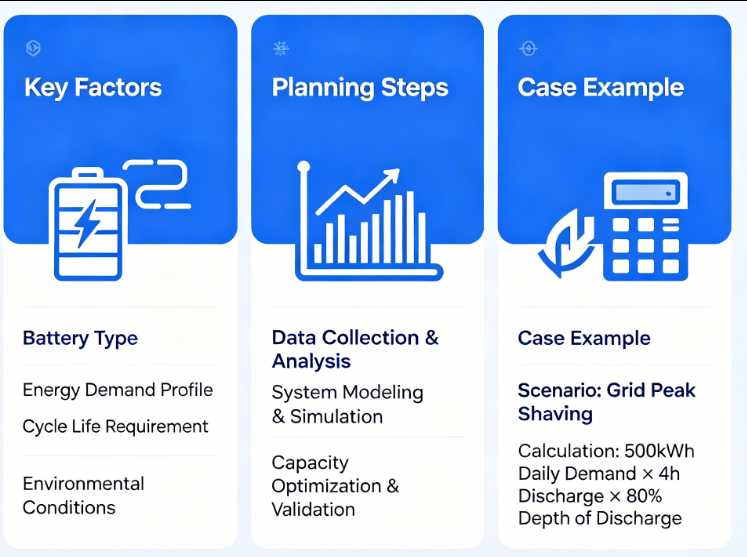
Capacity planning is a fundamental step in designing an energy storage battery system, whether for residential, commercial, or industrial use. It involves determining the optimal battery capacity (measured in kilowatt-hours, kWh) to meet the user’s energy needs, account for seasonal variations, and ensure reliable operation. Poor capacity planning can lead to insufficient energy storage (resulting in frequent power outages or reliance on the grid) or overcapacity (increasing upfront costs and wasting resources). Effective capacity planning requires a thorough analysis of energy demand, renewable energy generation (if paired with solar or wind), and battery performance characteristics.
The first step in capacity planning is to calculate the daily energy demand of the user or facility. For residential systems, this involves adding up the power consumption (in watts) of all electrical devices used daily, multiplied by the number of hours each device is used, and converting the total to kilowatt-hours (kWh). For example, a home with a 100-watt light used for 5 hours, a 1,000-watt refrigerator used for 24 hours, and a 1,500-watt heater used for 3 hours would have a daily energy demand of (100×5)/1000 + (1000×24)/1000 + (1500×3)/1000 = 0.5 + 24 + 4.5 = 29 kWh. Commercial or industrial systems require a more detailed analysis, including peak demand periods and seasonal variations in energy use.
Next, it is important to account for the renewable energy generation profile if the storage system is paired with solar or wind. For solar-powered systems, the amount of energy generated depends on the size of the solar panel array, the local solar irradiance (sunlight availability), and seasonal changes. For example, a 5 kW solar array in a region with an average daily solar irradiance of 4 hours would generate 5×4 = 20 kWh per day. If the daily energy demand is 29 kWh, the storage system needs to make up the difference (29 - 20 = 9 kWh) on sunny days. However, it is also necessary to account for cloudy days, where solar generation may be significantly lower. A common rule of thumb is to size the battery capacity to provide 2-3 days of backup power, ensuring that the system can operate independently even during extended periods of low renewable generation.
Battery performance characteristics also play a key role in capacity planning. The usable capacity of a battery is not the same as its nominal capacity, as it is affected by factors such as DoD, temperature, and aging. For example, a 10 kWh lithium-ion battery with a recommended DoD of 80% has a usable capacity of 8 kWh. Additionally, extreme temperatures can reduce the battery’s capacity—lithium-ion batteries may lose 10-20% of their capacity in cold weather (below 0°C) and 5-10% in hot weather (above 45°C). When planning capacity, it is important to factor in these losses to ensure the battery can meet the required energy demand under all operating conditions. Finally, it is advisable to include a 10-15% buffer in the battery capacity to account for unexpected increases in energy demand or decreases in renewable generation, ensuring the system remains reliable and flexible.




 59911926@qq.com/sales@goldenfuturehk.com
 13316809242 / 15816897019
 Inquiry
 Home >